

“I’m quitting my job and starting a business.”
Every week, I see someone post this on LinkedIn.
Thousands of likes.
Hundreds of comments saying:
“Congratulations!”
“Best decision ever!”
“Welcome to entrepreneurship.”
It feels exciting.
It feels brave.
It feels like the beginning of financial freedom.
But what social media doesn’t show you is what happens six months later.
The savings slowly disappear.
The excitement turns into stress.
Bills don’t stop.
Customers don’t magically appear.
Family members start asking uncomfortable questions.
And many people quietly return to a job—or worse, they give up on entrepreneurship completely.
You rarely see that post on LinkedIn.
Because failure is much quieter than success.
I know this because I’ve asked myself the same question many times.
Should I quit my corporate job and work on my startup full-time?
If you know me, I’m SRK Macha, founder of HelloMacha.com and someone who genuinely believes entrepreneurship can change lives.
At the same time, I also work a full-time corporate job.
For a long time, I wondered if I was making a mistake by not resigning.
Then I started reading stories from founders around the world.
Some built million-dollar companies.
Some regretted quitting.
Some wished they had waited.
Some nearly lost everything.
After reading dozens of founder experiences, one realization completely changed how I think about entrepreneurship.
Most successful founders don’t quit because they’re tired of their jobs. They quit because their businesses become impossible to run as side projects.
That sentence changed everything for me.
Because if I’m completely honest…
If I had quit my job too early,
I probably would have quit my startup too.
Not because my dream wasn’t real.
Not because I lacked passion.
But because financial pressure destroys patience.
When your savings are disappearing every month, you stop thinking like a builder and start thinking like someone trying to survive.
That’s when people make desperate decisions.
They chase every opportunity.
They change ideas every month.
They lose confidence.
Eventually, many give up—not because the startup couldn’t succeed, but because they ran out of time, money, or emotional energy.
This article is not here to discourage you from starting a business.
It’s here to prevent you from making one of the biggest financial mistakes of your life.
Over the last few weeks, I studied the experiences of founders, investors, and entrepreneurs from around the world—including people who built successful companies and people who openly admitted they regretted quitting too early.
Their stories all pointed to the same conclusion:
Entrepreneurship isn’t about having the courage to quit your job. It’s about knowing when quitting is the right decision.
If you’re thinking about leaving your job, starting a business, or building a startup, I want this guide to help you make a decision you’ll still be proud of five years from now.
Not next week.
Not after watching another motivational reel.
Five years from now.
Let’s begin.
The Biggest Lie About Entrepreneurship That Social Media Sells You

Open Instagram, LinkedIn, or YouTube for just ten minutes.
You’ll probably see someone saying:
“I quit my 9-to-5.”
“Now I work from anywhere.”
“Be your own boss.”
“Financial freedom is just one startup away.”
The posts are inspiring.
The office goodbye photos.
The airport selfies.
The laptop on the beach.
The funding announcements.
The luxury cars.
The screenshots of six-figure revenue.
They make entrepreneurship look like one long celebration.
But here’s something worth noticing.
Almost nobody posts about the months when nothing worked.
Nobody shares:
- The customer who never paid.
- The product that nobody wanted.
- The sleepless nights worrying about rent.
- The panic of watching savings disappear.
- The difficult conversation with family after another failed month.
- The interview they attended because they needed a job again.
Social media rewards success stories.
It rarely rewards honest stories.
That creates a dangerous illusion.
Many people don’t want to become entrepreneurs.
They simply want to escape their current jobs.
Those are two very different things.
Escaping a Job Is Not the Same as Building a Business
This is one of the biggest misconceptions I see.
Someone has:
- a difficult manager,
- low salary,
- office politics,
- long working hours,
- or feels unappreciated.
Then they conclude:
“I’ll quit my job and start a business.”
But think about it.
A business doesn’t remove problems.
It changes the type of problems you face.
Instead of one manager…
You now answer to customers.
Investors.
Vendors.
Employees.
Government regulations.
Cash flow.
Taxes.
Competition.
Technology.
Marketing.
Sales.
In a job, if one customer is unhappy, someone else usually handles it.
As a founder, you handle it.
At 10 PM.
On Sunday.
During your vacation.
Even while you’re eating dinner.
Entrepreneurship doesn’t remove responsibility.
It multiplies it.
“Be Your Own Boss” Sounds Great—Until You Realize You Have Hundreds of Bosses
One phrase has probably convinced more people to quit their jobs than any other:
“Be your own boss.”
It sounds empowering.
But after speaking with founders and reading countless entrepreneurial journeys, I’ve come to a different conclusion.
As an entrepreneur, you don’t have fewer bosses.
You have more.
Your customers become your boss.
If they stop buying, your revenue disappears.
Your employees become your responsibility.
If they leave unexpectedly, your operations suffer.
Your suppliers affect your delivery timelines.
Banks influence your financing.
Government policies impact your business.
The market decides whether your product survives.
Ironically, the only person you can’t blame anymore is your manager.
Everything comes back to you.
That’s not freedom.
That’s ownership.
And ownership is rewarding—but it’s also demanding.
Financial Freedom Doesn’t Start on the Day You Quit
This is another dangerous misconception.
Many people think:
Job → Quit → Startup → Financial Freedom
Reality usually looks like this:
Job → Side Project → Learning → Mistakes → Customers → More Mistakes → Small Revenue → Consistent Revenue → Full-Time Startup → Years of Growth → Financial Freedom
Notice what’s missing.
There is no overnight success.
There is no magical moment where resigning suddenly doubles your income.
In fact, for many founders, income drops before it grows.
That’s completely normal.
The mistake is expecting entrepreneurship to immediately replace the stability of a salary.
Freedom Comes Much Later Than People Think
People often say:
“I want freedom.”
Ironically, the first few years of entrepreneurship usually offer less freedom than a job.
You may work:
- Early mornings.
- Late nights.
- Weekends.
- Holidays.
Not because someone forces you.
Because your business depends on it.
There is no HR department.
No paid leave.
No guaranteed salary.
No annual bonus.
No one reminding you to take a break.
You create your own freedom—but only after building something valuable enough to support it.
The Problem Isn’t Entrepreneurship
I want to be very clear.
This article is not anti-business.
I’m an entrepreneur myself.
I believe building businesses creates jobs, solves problems, and changes lives.
The problem isn’t entrepreneurship.
The problem is unrealistic expectations.
People quit jobs expecting entrepreneurship to solve every problem in their lives.
When reality doesn’t match the fantasy, they don’t just quit the business.
They lose confidence in themselves.
That’s heartbreaking because many of those businesses might have succeeded if the founders had prepared differently.
My Biggest Realization
One realization changed the way I think about entrepreneurship.
Your salary isn’t the enemy of your startup.
For many founders, it’s the first investor.
It pays the rent while your startup earns its first customers.
It buys you time to experiment.
It reduces desperation.
It allows you to reject bad opportunities instead of accepting them just to survive.
Looking back, I don’t see my corporate job as something holding me back.
I see it as something that quietly gave my startup the chance to exist.
And I know this with complete honesty:
If I had resigned too early, I probably wouldn’t have become a full-time entrepreneur.
I would have become a stressed entrepreneur looking for another job.
Those are not the same thing.
What Successful Entrepreneurs Did Before They Quit Their Jobs

One thing surprised me while researching this article.
I expected successful entrepreneurs to have completely different journeys.
Different countries.
Different businesses.
Different ages.
Different industries.
But after reading their stories, I noticed something fascinating.
Although their businesses were different, their decision-making process was almost identical.
None of them woke up one morning and said,
“I’m quitting my job because I have a brilliant idea.”
Instead, they treated entrepreneurship like an investment.
They reduced risk before increasing it.
They tested before committing.
They prepared before jumping.
And that’s probably the biggest lesson every aspiring entrepreneur should learn.
Let’s look at what they actually did.
Read This: Sarah Ahmad’s founder story
Lesson 1: They Didn’t Quit Because They Hated Their Jobs
This lesson appeared again and again.
Sarah Ahmad explained it perfectly.
She didn’t leave because she was tired of employment.
She left because her startup had reached a point where her job was slowing its growth.
There’s a huge difference.
Many people quit to escape.
Successful founders usually quit to expand.
Think about those two motivations.
Escaping
- I hate my manager.
- I hate my office.
- My salary isn’t enough.
- I’m frustrated.
Expanding
- Customers are increasing.
- Revenue is growing.
- My startup needs more attention.
- My business has proven demand.
One decision comes from emotion.
The other comes from evidence.
Evidence wins almost every time.
Also Read: Ankur P. Agarwal’s LinkedIn post
Lesson 2: They Validated Before They Resigned
One sentence from Sarah Ahmad stayed with me.
She advised founders to:
Build before you quit.
That sounds simple.
But most people do the opposite.
They quit first.
Then they start building.
That’s incredibly risky.
Imagine opening a restaurant before checking whether anyone wants your food.
Or manufacturing a product before confirming someone will buy it.
A startup works the same way.
Validation means proving that real people are willing to pay for what you’re building.
Not your friends.
Not your family.
Not people clicking “Like” on LinkedIn.
Real customers.
Money is validation.
Compliments are not.
Also Read: Brenda Katwesigye’s article
Lesson 3: Every Founder Talked About Financial Runway

This was impossible to ignore.
Some recommended six months of savings.
Others recommended twelve.
The exact number varied.
The principle didn’t.
Money buys something far more valuable than comfort.
It buys time.
Time to improve the product.
Time to find customers.
Time to make thoughtful decisions.
Without savings, every month becomes a countdown.
Instead of asking,
“How do I build a great company?”
you start asking,
“How do I pay next month’s rent?”
That’s when panic replaces strategy.
One founder even admitted that financial pressure made them question every decision.
Not because the business was failing.
Because survival became the priority.
Also Read: Personal Finance Tips: 90-Day Plan for Financial Freedom
Lesson 4: They Used Their Jobs as Startup Capital
This idea completely changed my thinking.
I used to think a job delayed entrepreneurship.
Now I see that, for many people, a job actually enables it.
Your salary can pay for:
- Your website.
- Software subscriptions.
- Product development.
- Marketing experiments.
- Customer interviews.
- Business travel.
- Learning new skills.
More importantly, it pays your personal expenses.
That means your startup doesn’t have to.
Your business gets room to breathe.
That’s incredibly powerful.
Your salary may be the first investment your startup ever receives.
Also Read: Build Wealth: 7 Proven Money Laws for Long-Term Success
Lesson 5: They Didn’t Chase Motivation—They Built Discipline
One misconception I had when I was younger was believing successful founders were always motivated.
The more I read, the more I realized something else.
Motivation starts businesses.
Discipline builds them.
There will be days when you’re exhausted after work.
Days when nobody replies to your emails.
Days when your product doesn’t improve.
Days when your marketing fails.
Days when you question everything.
The entrepreneurs who eventually succeed aren’t necessarily the smartest.
They’re often the ones who keep showing up.
Consistency quietly beats excitement.
Every single time.
Also Read: Daily Gold Investment vs Gold ETF SIP: A Real-World Review With ₹500 Monthly Example
Lesson 6: None of Them Expected Overnight Success
One entrepreneur left a ₹1 crore salary in the United States.
Another spent years building before seeing real momentum.
Others openly admitted they regretted quitting too early.
What connects all these stories?
Patience.
No one described entrepreneurship as a six-month journey.
Most described it as a five- to ten-year commitment.
That changes everything.
If your expectation is becoming financially free within one year, you’re likely setting yourself up for disappointment.
But if you’re building something meaningful over the next decade, temporary setbacks become much easier to accept.
The Pattern Was Impossible to Ignore
After reading founder stories from India, Africa, the United States, and startup investors around the world, I wrote one sentence in my notebook.
It eventually became the biggest lesson from this entire research.
Successful entrepreneurs don’t gamble with their future. They systematically reduce risk before taking bigger risks.
That’s not fear.
That’s wisdom.
The media celebrates the day they resigned.
It rarely shows the years they spent preparing before that moment.
And perhaps that’s why so many people misunderstand entrepreneurship.
They copy the last chapter of someone else’s story.
Without reading the first ten.
What This Means for You
If you’re thinking about quitting your job to start a business, don’t ask yourself:
“Am I brave enough to quit?”
Ask yourself:
- Have I validated my idea?
- Do I have paying customers?
- Do I have enough savings?
- Is time truly my biggest bottleneck?
- Would working six more months make my startup significantly stronger?
Those questions won’t go viral on LinkedIn.
But they might save your business.
10 Signs You’re NOT Ready to Quit Your Job Yet

If you’ve already decided to resign, this section may make you uncomfortable.
That’s okay.
Sometimes uncomfortable advice saves years of regret.
One thing became clear while researching this article.
The entrepreneurs who eventually succeeded weren’t necessarily the boldest.
They were usually the most prepared.
So before you submit your resignation letter, honestly answer these ten questions.
If several of these describe you, your next step isn’t quitting your job.
Your next step is strengthening your startup.
1. You Don’t Have a Paying Customer Yet
This is the biggest warning sign.
People often tell me,
“My idea is amazing.”
Maybe it is.
But ideas don’t pay salaries.
Customers do.
Ask yourself:
Has anyone ever paid for what you’re building?
Not promised.
Not said,
“This is interesting.”
Actually paid.
Money is one of the strongest forms of validation.
If nobody is willing to buy today, quitting your job won’t suddenly change that.
Instead of resigning, focus on getting your first paying customer.
That milestone is far more important than your resignation date.
2. Your Startup Depends Entirely on Hope
Hope is important.
But businesses cannot survive on hope alone.
If your business plan sounds like this…
- “People will definitely buy.”
- “I’m sure marketing will work.”
- “Investors will come.”
- “Once I quit, everything will grow.”
…you’re making assumptions instead of decisions.
Replace hope with evidence.
Evidence looks like:
- Customer interviews.
- Sales.
- Revenue.
- Repeat customers.
- Testimonials.
- Growing demand.
Hope starts businesses.
Evidence grows them.
3. You Have Less Than Six Months of Savings
Imagine this situation.
You resign today.
Your startup earns almost nothing for the next six months.
Can you survive?
Can you pay:
- Rent?
- EMI?
- Groceries?
- Electricity?
- Insurance?
- Internet?
- Family responsibilities?
Without borrowing money?
If the answer is no, your startup isn’t your biggest risk.
Running out of money is.
Personally, I believe savings don’t just protect your finances.
They protect your decision-making.
A founder who has time makes better choices than a founder who is desperate.
4. You’re Trying to Escape Your Job
This one is personal.
Many people don’t actually want entrepreneurship.
They just want relief.
A bad manager.
Office politics.
Low salary.
Long commute.
Toxic workplace.
Those are valid reasons to change jobs.
They’re not necessarily good reasons to build a company.
A new job might solve those problems.
A startup introduces completely different ones.
Don’t confuse frustration with readiness.
5. Your Family Doesn’t Know Your Financial Reality
Entrepreneurship affects more than one person.
If your parents…
Your spouse…
Your children…
Depend on your income,
they deserve honesty.
That doesn’t mean they must approve every decision.
But they should understand:
- Your savings.
- Your financial runway.
- Your risks.
- Your backup plan.
Building a startup without these conversations often creates unnecessary pressure later.
Great businesses are easier to build when expectations are clear.
6. You Think More Time Will Solve Everything
This myth fooled many founders.
“I just need more time.”
Maybe.
But ask yourself something deeper.
What exactly would you do differently?
Would you suddenly become better at:
- Sales?
- Marketing?
- Customer research?
- Product design?
- Leadership?
Or would you simply have more free hours?
More time only helps if time is actually your biggest bottleneck.
If customers aren’t buying today, quitting tomorrow may not change that.
7. You’re Still Changing Your Idea Every Month
One week it’s an AI startup.
Next month it’s e-commerce.
Then SaaS.
Then digital marketing.
Then consulting.
Then something else.
Constantly changing direction usually means you haven’t committed long enough to learn.
Every business feels exciting at the beginning.
Every business becomes difficult after a few months.
Don’t mistake normal difficulty for a bad idea.
Sometimes persistence is the missing ingredient.
8. You Haven’t Learned How to Sell
Many first-time founders focus on:
- Product.
- Logo.
- Website.
- Business cards.
- Branding.
Very few spend enough time learning sales.
Here’s the truth.
A simple product that solves a real problem and is sold effectively beats a perfect product nobody knows exists.
If selling feels uncomfortable today, practice while you still have a salary.
Sales is a skill.
Like any skill, it improves through repetition.
9. Your Startup Can’t Survive Without You Working Every Hour
Ask yourself:
Can this business eventually become a system?
Or is it just another job that pays less?
Many people unknowingly create businesses that require them to work 16 hours every day forever.
That’s not freedom.
That’s self-employment without scalability.
Before quitting, think about whether your business can eventually grow beyond your daily effort.
10. You Don’t Have a Backup Plan
Here’s something many people misunderstand.
Having a backup plan doesn’t make you less committed.
It makes you more responsible.
Ask yourself:
If this startup doesn’t work after two years…
What will I do?
Return to employment?
Pivot?
Freelance?
Consult?
Start another business?
Thinking through these possibilities isn’t pessimistic.
It’s practical.
Even experienced entrepreneurs prepare for multiple outcomes.
You should too.
My Personal Checklist
Whenever I think about leaving my corporate job, I ask myself five simple questions.
Not because I’m afraid.
Because I want to build something that lasts.
✔ Is my startup generating consistent revenue?
✔ Am I leaving because of growth—not frustration?
✔ Do I have enough savings to survive without panic?
✔ Is my job actually slowing down my startup?
✔ Would quitting today increase my chances of success—or simply increase my stress?
If I can’t confidently answer all five,
I know exactly what I need to do.
Keep building.
The Hard Truth
The best time to quit your job isn’t when you’re tired.
It isn’t when you watch another motivational video.
It isn’t when someone on LinkedIn announces they’re now a full-time founder.
It’s when your startup has grown so much that keeping your job becomes the bigger risk than leaving it.
That’s a completely different mindset.
And it’s the mindset I saw repeated across almost every successful entrepreneur I researched.
The Startup Readiness Framework: When Is the Right Time to Quit Your Job?
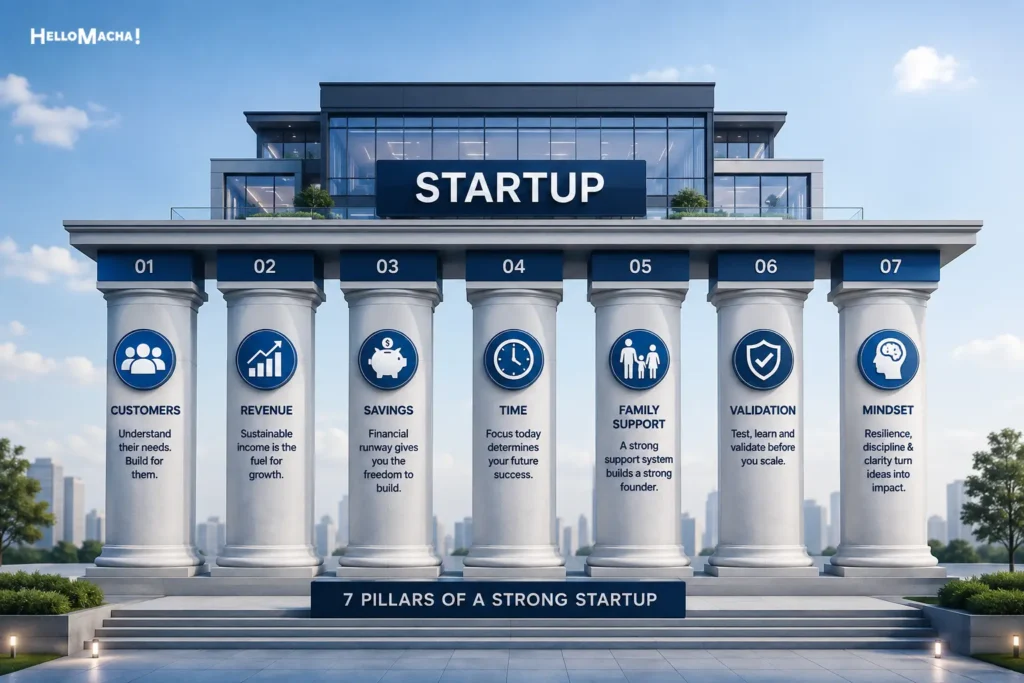
If you’ve read this far, you’ve probably realized something.
There isn’t a perfect date on the calendar that tells you it’s time to resign.
Nobody sends an email saying,
“Congratulations! You’re officially ready to become a full-time entrepreneur.”
Instead, the decision comes from preparation.
After reading founder stories, investor advice, and reflecting on my own journey, I created a framework that I now use personally.
I call it the Startup Readiness Framework.
It isn’t based on motivation.
It isn’t based on social media.
It isn’t based on fear.
It’s based on evidence.
If I ever resign from my corporate job, I want to know that I earned the decision—not that I guessed.
Pillar 1: Your Business Has Proven That People Will Pay
This is the first checkpoint.
Not because it’s the most exciting.
Because it’s the most important.
Many startups fail for one simple reason:
They build something nobody is willing to buy.
Before resigning, ask yourself:
- Have strangers paid for my product or service?
- Are customers coming back?
- Am I solving a real problem?
- Have I received referrals from existing customers?
- Can I clearly explain why customers choose me?
Notice what isn’t on this list.
Followers.
Likes.
Views.
Comments.
Those metrics feel good.
Revenue builds businesses.
If your startup isn’t generating real value for customers, more free time won’t fix that.
Customer validation comes before career transition.
Pillar 2: Your Revenue Is Becoming Predictable
One customer is encouraging.
Ten customers are exciting.
Consistent customers change everything.
The question isn’t:
“Did I make money this month?”
The better question is:
“Can I reasonably expect to make money next month?”
Predictability matters.
If revenue disappears every other month, your business is still fragile.
That doesn’t mean you can’t become successful.
It simply means your foundation isn’t stable yet.
A salary arrives every month.
Your startup should show signs that it can eventually do the same.
Pillar 3: Your Salary Is No Longer the Biggest Supporter of Your Dream
This pillar took me a long time to understand.
Earlier, I believed my job and my startup were competing with each other.
Now I see them as partners.
My salary pays for:
- My living expenses.
- My experiments.
- My mistakes.
- My learning.
- My patience.
The day my startup can comfortably replace those responsibilities is the day I know it’s becoming independent.
Until then, my job isn’t holding my dream back.
It’s protecting it.
Pillar 4: Time Has Become Your Biggest Bottleneck
This is one of the few situations where quitting actually makes sense.
Ask yourself honestly.
What is stopping your startup from growing today?
If the answer is:
“I don’t have enough hours to serve customers.”
or
“I’m turning away business because I can’t handle demand.”
That’s a good problem.
It means growth is waiting for you.
But if the answer is:
“I don’t know how to get customers.”
or
“I haven’t figured out marketing.”
More free time won’t automatically solve those problems.
Skills—not hours—are your real bottleneck.
Know the difference.
Pillar 5: You Have Enough Runway to Make Good Decisions
Imagine two founders.
Founder A has one month of savings.
Founder B has one year of savings.
Both have the same startup.
Who makes better decisions?
Usually Founder B.
Why?
Because desperation changes behavior.
Founders without runway often:
- Accept bad clients.
- Cut prices too quickly.
- Chase every opportunity.
- Abandon long-term thinking.
- Panic when results take longer than expected.
Money doesn’t guarantee success.
But it gives you the freedom to make thoughtful decisions instead of desperate ones.
Pillar 6: Your Family Understands the Journey
Entrepreneurship isn’t only your decision.
It affects everyone who depends on you.
If you’re single, this conversation may be simple.
If you’re supporting parents, a spouse, or children, it’s very different.
One lesson I learned while researching this article is that the strongest founders don’t hide reality.
They communicate it.
Your family doesn’t need unrealistic promises.
They need honesty.
Explain:
- Why you’re making this decision.
- How much you’ve saved.
- What your plan is.
- What happens if things take longer than expected.
Trust grows when expectations are clear.
Pillar 7: You’re Leaving Because You’re Ready—Not Because You’re Frustrated
This might be the most important pillar of all.
Ask yourself one question.
If your manager suddenly became amazing…
If your salary doubled tomorrow…
Would you still want to build this startup?
If the answer is yes,
You’re probably building for the right reasons.
If the answer is no,
Maybe entrepreneurship isn’t what you’re chasing.
Maybe you’re simply looking for a better job.
Those are completely different decisions.
The SRK Macha Startup Scorecard
Whenever I think about resigning, this is the scorecard I’ll use.
| Question | Yes | No |
|---|---|---|
| Do I have paying customers? | ☐ | ☐ |
| Is revenue becoming consistent? | ☐ | ☐ |
| Do I have at least 6–12 months of savings? | ☐ | ☐ |
| Is time truly my biggest bottleneck? | ☐ | ☐ |
| Can my startup support my basic expenses soon? | ☐ | ☐ |
| Does my family understand the plan? | ☐ | ☐ |
| Am I quitting because of opportunity—not frustration? | ☐ | ☐ |
| Would I build this business even if nobody praised me online? | ☐ | ☐ |
Score Interpretation
0–3 Yes:
Keep your job. Focus on validation, customers, and learning.
4–6 Yes:
You’re making progress. Continue building while employed and strengthen the weak areas.
7–8 Yes:
You’re approaching the point where a full-time transition may be a rational decision—not because it’s trendy, but because your business is earning it.
A Decision I’ll Never Regret
When I first started my entrepreneurial journey, I thought courage meant resigning.
Today, I think differently.
Courage isn’t leaving a job without a plan.
Courage is patiently building something valuable while everyone else is chasing shortcuts.
If my startup reaches the point where it genuinely needs me full-time, I’ll resign with confidence.
Not because social media told me to.
Not because someone called me brave.
Because the business earned that decision.
And if that day takes another year…
or two…
I’ll still be building.
Because I’m not trying to become someone who quit a job.
I’m trying to become someone who built a business that deserved my full attention.
A Letter to Anyone Thinking About Quitting Their Job Today

Dear Future Entrepreneur,
Maybe you’re reading this late at night after finishing work.
Maybe you’re frustrated with your manager.
Maybe you’re tired of office politics.
Maybe you’re looking at another founder on LinkedIn announcing,
“I finally quit my job to build my startup full-time.”
And maybe you’re wondering,
“Should I do the same?”
I understand that feeling.
I’ve been there.
I’m still there.
Every entrepreneur reaches that crossroads.
One road says,
Stay employed.
The other says,
Build your dream.
People often assume those two roads go in opposite directions.
I don’t think they do.
Sometimes, they run side by side for a long time.
And that’s perfectly okay.
Don’t Let Social Media Decide Your Future
One post.
One viral video.
One motivational speech.
One podcast.
None of these know your financial situation.
None of them know your responsibilities.
None of them know your parents depend on you.
None of them know you’re paying an EMI every month.
None of them know your startup hasn’t found its first customer yet.
Only you know those things.
Your life is too important to be influenced by someone else’s highlight reel.
Make decisions based on your reality—not someone else’s success story.
Your Job Is Not Your Enemy
For a long time, I looked at my job and my startup as competitors.
Today, I see them differently.
My job has done something my startup couldn’t do in its early days.
It gave me stability.
It paid my bills.
It allowed me to experiment without panic.
It bought me time.
That doesn’t mean I’ll stay employed forever.
It simply means I refuse to treat my salary as something to escape.
Instead, I treat it as fuel for building something bigger.
If you’re still employed while building your dream, don’t feel guilty.
Feel grateful.
Use this phase wisely.
Build Quietly
One thing I’ve learned is this:
You don’t need to announce every step.
You don’t need to post,
“Big announcement coming soon.”
You don’t need to update LinkedIn every week saying you’re “working on something exciting.”
Some of the strongest businesses are built quietly.
While everyone is talking…
Someone else is improving their product.
Calling customers.
Fixing bugs.
Learning sales.
Building trust.
Eventually, the results speak much louder than announcements ever could.
Entrepreneurship Is Not a Race
One founder succeeds at twenty-three.
Another succeeds at forty-five.
Someone builds a unicorn.
Someone builds a profitable local business that supports their family for decades.
Both are successful.
Don’t measure your journey using someone else’s timeline.
Measure it by your own progress.
Every customer you help.
Every mistake you learn from.
Every skill you develop.
Every month you stay consistent.
Those things compound over time.
Success Isn’t Quitting Your Job
This is probably the biggest lesson I want you to remember.
Quitting your job is not an achievement.
Building a sustainable business is.
One is a decision.
The other is years of execution.
People celebrate resignations because they’re dramatic.
Customers celebrate businesses because they create value.
Focus on becoming valuable.
The resignation will happen naturally when the time is right.
My Promise to Myself
As I wrote this article, I made a promise to myself.
I won’t resign because I’m tired.
I won’t resign because entrepreneurship looks glamorous.
I won’t resign because someone else tells me it’s the only way to succeed.
I’ll resign when my business gives me a reason to.
Until then…
I’ll keep learning.
I’ll keep building.
I’ll keep improving.
I’ll keep serving customers.
I’ll keep making mistakes.
I’ll keep showing up.
Because every small step today makes the big leap less risky tomorrow.
If You Remember Only One Thing…
After reading founder stories from different countries, industries, and backgrounds, I realized they all arrived at the same conclusion in different words.
So let me leave you with mine.
Don’t quit your job to start a business. Build a business that eventually makes quitting your job the obvious next step.
That one sentence can save years of frustration.
And maybe…
Just maybe…
It’ll help you build something that lasts.
See you on the journey.
— SRK Macha
Founder, HelloMacha.com

Final Thoughts
If this article helped you rethink your decision, don’t keep it to yourself.
Share it with:
- A friend planning to quit their job.
- A colleague dreaming of starting a business.
- Someone who believes entrepreneurship is an overnight shortcut to wealth.
It might save them from making a decision they’ll regret—and help them make one they’ll be proud of.

FAQs
1. Should I quit my job to start a business?
Not immediately. Validate your idea, get paying customers, save enough money, and make sure your startup genuinely needs your full-time attention.
2. When is the right time to quit a job for a startup?
The best time is when your startup has consistent customer demand, financial runway, and your job becomes the main limitation to growth.
3. How much money should I save before quitting my job?
Most experienced entrepreneurs recommend saving 6–12 months of living expenses before transitioning to full-time entrepreneurship.
4. Can I build a startup while working full-time?
Yes. Many successful founders built and validated their startups during evenings and weekends before resigning.
5. Is quitting my job necessary to become successful?
No. Quitting your job doesn’t create success. Building a sustainable business does.
6. Should I quit my job without customers?
No. Your first priority should be finding paying customers, not submitting your resignation.
7. What if I hate my current job?
A bad job doesn’t automatically mean entrepreneurship is the right answer. Sometimes changing employers is a better first step.
8. How do I know if my startup idea is good?
A startup idea is good when customers are willing to pay for it—not just praise it.
9. What is startup validation?
Startup validation means proving that real customers need your product or service and are willing to pay for it.
10. Is entrepreneurship financially risky?
Yes. That’s why preparation, savings, and customer validation are critical before quitting a stable income.
11. How long does it take for a startup to become profitable?
It varies by industry, but many successful businesses take several years to reach stable profitability.
12. Can I become financially free through entrepreneurship?
Yes, but financial freedom usually comes after years of consistent execution—not immediately after quitting your job.
13. Is entrepreneurship better than a corporate job?
Neither is universally better. The right choice depends on your goals, financial situation, and risk tolerance.
14. Should I quit my job because of burnout?
No. Burnout should be addressed separately. Starting a business while exhausted often creates new challenges.
15. Can my salary help my startup?
Absolutely. Your salary can fund product development, marketing, and living expenses while your startup grows.
16. What is financial runway?
Financial runway is the amount of time you can support yourself without depending on your startup’s income.
17. Should I tell my family before quitting?
Yes. Entrepreneurship affects the whole household. Open discussions help set realistic expectations.
18. What skills should I learn before starting a business?
Sales, marketing, finance, customer research, negotiation, and communication are among the most valuable skills.
19. Is social media giving a realistic picture of entrepreneurship?
Usually not. Social media often highlights success while hiding the long periods of struggle behind it.
20. What are the biggest mistakes first-time founders make?
Quitting too early, running out of money, ignoring customer validation, and expecting quick success.
21. Can I return to a job if my startup fails?
Yes. Many successful entrepreneurs returned to employment, gained experience, and later built stronger businesses.
22. Should I wait until my startup earns my full salary?
Not necessarily, but your revenue should be consistent enough to show sustainable growth.
23. How do I reduce startup risk?
Validate early, save money, keep learning, and build your business before leaving your job.
24. Is being my own boss easier?
No. Entrepreneurs answer to customers, employees, vendors, and the market.
25. What is the biggest lesson from this article?
Don’t quit your job to start a business.
Build a business that eventually makes quitting your job the obvious next step.